
In the first of our Future of Dentistry series, we look at peptides and why these tiny chains of amino acids could have an increasingly important role in oral care.
Contents
Future of Dentistry: Could Peptides Change the Way We Care for our Teeth and Gums?
Peptides’ Role in Biomimetic Dentistry
Can Peptides Actually Help Repair Enamel?
Peptide Dental Care in Everyday Products
What Could Peptide Dentistry Look Like in the Future?
What’s Next in our Future of Dentistry Series?
Dentistry is becoming more biological – traditional dentistry focused heavily on repairing damage once it has occurred, whereas modern research is looking at ways to work with the body’s own biological processes to prevent damage, support natural repair and encourage healthier oral tissues.
This shift towards a more biological approach is opening up new possibilities for how we care for teeth and gums. Instead of simply removing damaged tissue or controlling bacteria with broad-spectrum ingredients, future treatments may be designed to interact more precisely with the oral environment. This could include supporting remineralisation, influencing the balance of bacteria within the mouth, or helping tissues recover more effectively.
Peptides are one of the areas attracting particular interest. Because different peptides can perform very specific biological functions, researchers are exploring how they could be used to support enamel, manage harmful biofilms and potentially contribute to regenerative dental treatments. This line of research represents a move towards dentistry that is not only restorative, but increasingly preventative, responsive and biologically driven.
Peptides are short chains of amino acids – essentially smaller relatives of proteins. They occur naturally throughout the body and are involved in many different biological processes, acting as signals that help cells communicate and respond to what is happening around them. Different peptides can perform very different biological functions, specific to the gland or organ they are derived from.
Ongoing research is exploring whether particular peptides could be used to interact with teeth, bacteria and oral tissues in more precise ways than conventional ingredients alone.
“Biomimetic dentistry” is the practice of developing dental treatments that imitate or support processes occurring naturally within the body. This is a relatively modern area of research and there are three broad areas that make this up:
Supporting mineralisation
Certain self-assembling peptides are being investigated for their ability to provide a structure around which minerals can form. P11-4 is currently one of the best-studied examples, particularly in relation to early enamel lesions.
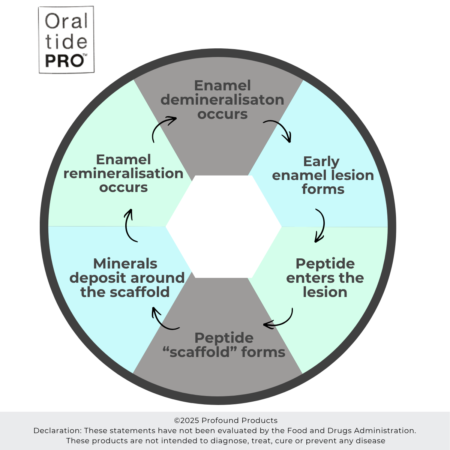
P11-4 is a specially designed self-assembling peptide being studied for its ability to support the remineralisation of early enamel damage. Once inside a demineralised area, it forms a microscopic scaffold that can encourage minerals from saliva to deposit and help rebuild the mineral structure of the enamel.
Helping manage oral bacteria and biofilms
Antimicrobial peptides are being researched for their ability to act against organisms within dental plaque and other oral biofilms. Recent research [1] is looking at potential applications involving caries, periodontal biofilms, root-canal infections and peri-implant disease.
Supporting repair and regeneration
Peptide and protein-based approaches are also being investigated within regenerative dentistry, including periodontal tissue repair and other approaches designed to encourage biological healing rather than simply replace damaged tissue.
Tooth enamel is incredibly strong, but unlike many other tissues in the body, it cannot simply grow back once it has been lost. However, in the very early stages of tooth decay, before a cavity has formed, enamel can still undergo remineralisation. This is the process where minerals such as calcium and phosphate are redeposited into weakened areas of the enamel.
Enamel demineralisation and remineralisation processes
When enamel begins to demineralise, microscopic pores develop beneath the tooth surface. Without intervention, this mineral loss can continue, weakening the enamel and allowing an early lesion to progress into a cavity. At this early stage, however, the enamel structure is still largely intact, which means there may be an opportunity to encourage remineralisation before more permanent damage occurs.
Peptides that support remineralisation are designed to move into these early lesions and self-assemble into a three-dimensional “scaffold”. This scaffold can then provide a structure around which the minerals naturally present in saliva, including calcium and phosphate, can deposit and contribute to the formation of new hydroxyapatite crystals. Hydroxyapatite is the main mineral component of healthy tooth enamel.
This makes peptide-based approaches different from simply placing a protective coating over the tooth. The aim is to encourage mineral formation within the weakened area itself, supporting the tooth’s natural remineralisation processes. However, it is important to distinguish remineralising early enamel damage from regrowing enamel or teeth. Peptides cannot currently replace enamel that has been physically lost through an established cavity, fracture or significant erosion. Their benefit lies primarily in intervening at an earlier stage, while the structure of the enamel is still present but has begun to lose minerals.
Research is currently looking at an interesting shift in dentistry: instead of waiting for early damage to progress to the point where a filling is required, future treatments may increasingly focus on helping the tooth repair that damage at a much earlier stage.
Conventional antibacterial approaches tend to concentrate on killing or reducing microorganisms; without a doubt, this approach still has a place, especially in cases of severe periodontitis where teeth are falling out and there is widespread infection. However, peptide technologies may give access to more selective ways of disrupting harmful organisms or biofilms, especially when used on an ongoing or everyday basis.
This is where products such as Oraltide™ Mouthwash fit into the wider conversation around the future of dental care. Rather than relying on a harsh, one-dimensional approach to oral hygiene, Oraltide™ is designed to form part of a regular routine that supports a healthier oral environment and complements normal brushing, interdental cleaning and professional dental care.
The future of dentistry may increasingly be about working with biology rather than simply repairing the consequences of poor oral hygiene and disease. The key message – prevention rather than restoration – can be supported with more biologically active oral-care products, targeted management of harmful biofilms and supporting natural enamel remineralisation through regenerative approaches to dental tissues.
Peptide dental care is just one part of a much wider shift towards more preventative, biological and personalised approaches to oral health.
In the next articles in our Future of Dentistry series, we’ll explore emerging research into enamel remineralisation, antimicrobial peptides and plaque control, alongside the rapidly developing science of the oral microbiome and biomimetic dentistry. Together, these areas are helping to change the way we think about oral health – moving beyond simply treating problems towards understanding, supporting and working with the natural biology of the mouth.
Look out for:
Can Peptides Help Remineralise Enamel?
A closer look at how self-assembling peptides are being researched to support mineral deposition within early enamel lesions.
Antimicrobial Peptides: The Future of Plaque Control?
Exploring whether peptides could offer more selective ways of managing harmful oral bacteria and disrupting dental biofilms.
Oral Microbiome Science: Why the Balance of Bacteria Matters
A look at the complex community of microorganisms living within the mouth, how changes to this balance can influence oral health and why future dental care may focus increasingly on supporting a healthy microbiome rather than simply eliminating bacteria.
Can Dentistry Regenerate Rather Than Repair?
Exploring how advances in regenerative dentistry could change the way damaged teeth, gums and supporting tissues are treated in the future.
What Is Biomimetic Dentistry?
An introduction to an approach that aims to preserve natural tooth structure and use materials and techniques designed to mimic the properties and behaviour of healthy teeth.
Resources
[1] National Library of Medicine: The Role and Progress of Antimicrobial Peptides in Managing Oral Biofilms: A Narrative Review (2025)